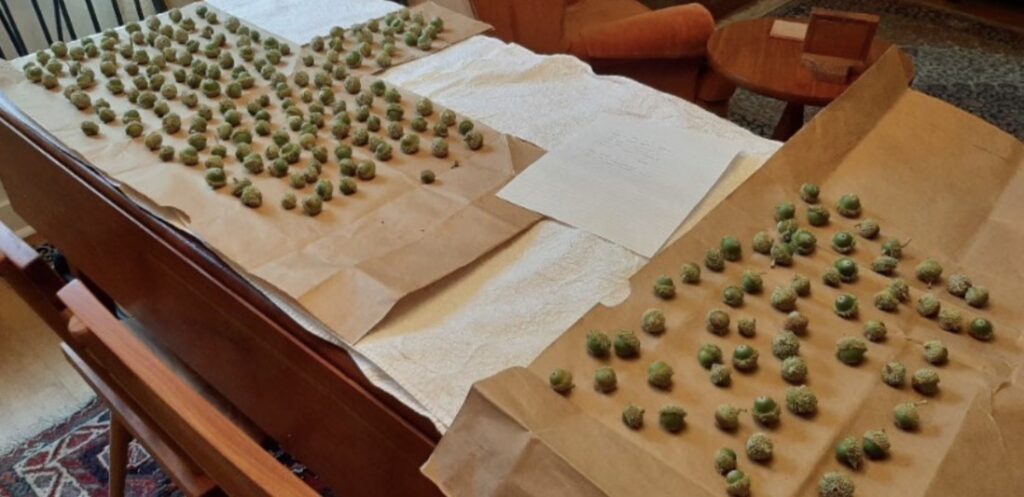
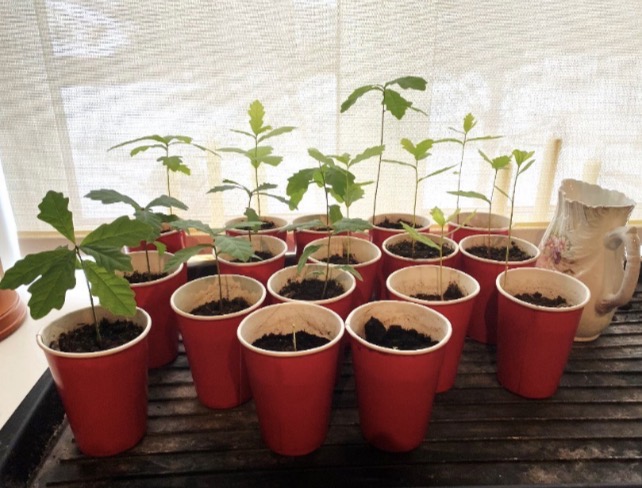
In the spring of 2021, I was invited by the Nature Trust of New Brunswick to help plant some twenty bur oak seedlings along the beautiful Keswick River. The one year old seedlings were grown from acorns by an NT employee (Aaron Dowding) on his own volition and in a low profile way. A single afternoon by the river made a quick convert of me and I started to consider how the the scale of the work could be increased a bit and how the seedlings could be used in support of the NT stewardship activities.
It was easy to promote such an attractive cause and we set our sights initially on all the planning and development activities required to be ready for a significant number of acorns in the fall of 2021. This activity resulted in general agreement, within our group and with the Nature Trust, that we should set up a “proof of concept” project to test the viability of our concept.
The project concept was a reflection of some principles, values, and attributes as follows:
- migration of buroak DNA from places of risk to places of relative safety
- project to be volunteer based with minimal paid NT staff involvement
- local DNA
- hands on experiential learning
- not a science experiment
- low budget
- low profile until measurable results were actually achieved
- low dependency on possibly intermittent government grants
- respectful use of natural resources such as acorns, people, and the land itself
- “engagement with nature opportunities” for young people
- no requirement for a formal science educational background
- all seedlings to be planted on legally protected NTNB land
- development of stewardship practices fostering high survival rates
- a forest regeneration project
- belief that positive impact can be achieved even with small scale projects
- techniques can be easily understood and mastered
- tactical decision-making and direction setting should be done at the project level
The fall of 2021 was a project milestone as we collected about 300 acorns for planting in 2022. Also we purchased five seedlings from a tree nursery which only uses local trees as seed sources. It was a symbolically important start!
In 2022 we implemented our decentralized (multiple growers, multiple local acorn sources, multiple grow box locations) growing model and that fall planted 300 seedlings in three locations. All were grown from our collected acorns in our own backyards. Our approach in 2022 was to plant a modest number of seedlings but to provide high end protection to all seedlings in the form of chickenwire cylinders and rebar stakes. We quickly discovered that cutting adjacent competing weeds had to be a priority.
We were able to repeat this proven cycle in 2023, 2024, and 2025 always being careful to collect only the number of acorns we could actually nurture and plant out in due course. Also, it may be necessary to cut back on planned harvesting levels if acorn production is down in a given year.
2026 will be a busy year and hopefully a milestone year for our project. We expect to do a careful inventory count in 2026 to determine how close we are to our self imposed phase 1 target of 500 seedlings. We will be working with the seedlings planted in the last three years (weed control, protective cone maintenance and removal where appropriate, and collecting acorns for 2027.
I would be remiss if I failed to thank all the volunteers who have helped over the years and especially all the core team members who can always be counted on to put aside personal activities in order to help with the trees when really needed. Also I would like to thank the NTNB board who gave permission for use of some protected land to be devoted to this forest regeneration project. Without their long term commitment, none of the goals achieved would have been realized.
In my opinion, we have found that the original concept is viable. And furthermore our results can be achieved by others. We are not saying this is the best way or the only way, but only that it works and that it can be replicated by others.
I would be pleased to talk with people who may be interested in exploring this further.
Frank Camm 506.259.5026
Frank has generously allowed the JGLWA to share his manual for Bur Oak propagation. It is available to view here

