Jemseg Grand Lake Watershed Association

New Brunswick, Canada

Join Us Donate
  • Home
  • About Us
    • About the Association
    • Membership
    • Partners and Supporters
    • Board of Directors
  • Projects
    • Education
      • Webinars
      • Workshops
      • Cyanobacteria
    • Shoreline Green Zones
    • Water Quality Monitoring
  • Resources
    • Explore Our Watershed
    • Newsletters
    • Resources for Educators
    • Reports
    • WAWA Handbook
  • Calendar
  • News
  • Contact Us
  • Shop
  • Login
    • Board of Directors
    • Members

Citizen Science Success Story: Bur Oak Tree Planting with Frank Camm

June 3, 2026

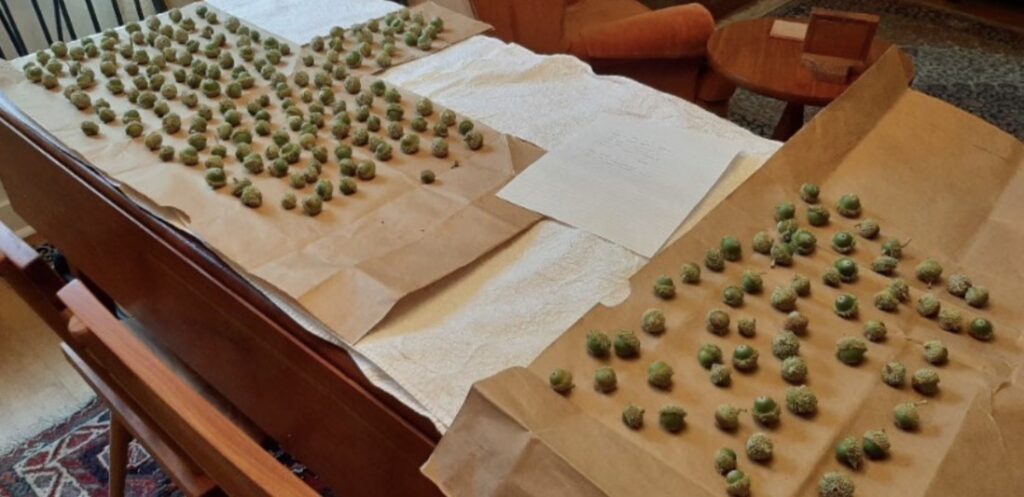
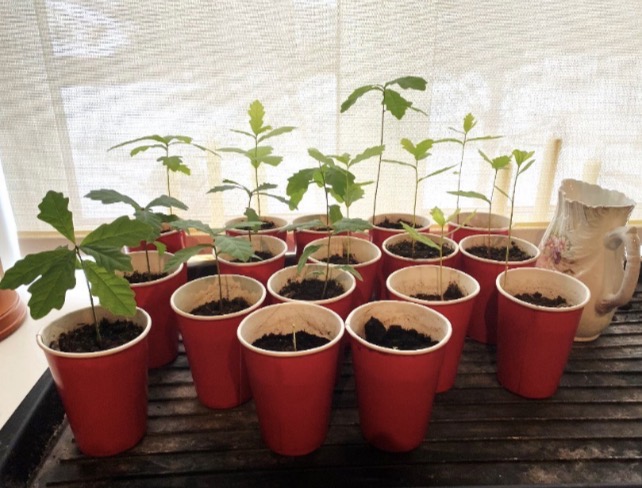
In the spring of 2021, I was invited by the Nature Trust of New Brunswick to help plant some twenty bur oak seedlings along the beautiful Keswick River. The one year old seedlings were grown from acorns by an NT employee (Aaron Dowding) on his own volition and in a low profile way. A single afternoon by the river made a quick convert of me and I started to consider how the the scale of the work could be increased a bit and how the seedlings could be used in support of the NT stewardship activities.

It was easy to promote such an attractive cause and we set our sights initially on all the planning and development activities required to be ready for a significant number of acorns in the fall of 2021. This activity resulted in general agreement, within our group and with the Nature Trust, that we should set up a “proof of concept” project to test the viability of our concept.

The project concept was a reflection of some principles, values, and attributes as follows:

  1. migration of buroak DNA from places of risk to places of relative safety
  2. project to be volunteer based with minimal paid NT staff involvement
  3. local DNA
  4. hands on experiential learning
  5. not a science experiment
  6. low budget
  7. low profile until measurable results were actually achieved
  8. low dependency on possibly intermittent government grants
  9. respectful use of natural resources such as acorns, people, and the land itself
  10. “engagement with nature opportunities” for young people
  11. no requirement for a formal science educational background
  12. all seedlings to be planted on legally protected NTNB land
  13. development of stewardship practices fostering high survival rates
  14. a forest regeneration project
  15. belief that positive impact can be achieved even with small scale projects
  16. techniques can be easily understood and mastered
  17. tactical decision-making and direction setting should be done at the project level

The fall of 2021 was a project milestone as we collected about 300 acorns for planting in 2022. Also we purchased five seedlings from a tree nursery which only uses local trees as seed sources. It was a symbolically important start!

In 2022 we implemented our decentralized (multiple growers, multiple local acorn sources, multiple grow box locations) growing model and that fall planted 300 seedlings in three locations. All were grown from our collected acorns in our own backyards. Our approach in 2022 was to plant a modest number of seedlings but to provide high end protection to all seedlings in the form of chickenwire cylinders and rebar stakes. We quickly discovered that cutting adjacent competing weeds had to be a priority.

We were able to repeat this proven cycle in 2023, 2024, and 2025 always being careful to collect only the number of acorns we could actually nurture and plant out in due course. Also, it may be necessary to cut back on planned harvesting levels if acorn production is down in a given year.

2026 will be a busy year and hopefully a milestone year for our project. We expect to do a careful inventory count in 2026 to determine how close we are to our self imposed phase 1 target of 500 seedlings. We will be working with the seedlings planted in the last three years (weed control, protective cone maintenance and removal where appropriate, and collecting acorns for 2027.

I would be remiss if I failed to thank all the volunteers who have helped over the years and especially all the core team members who can always be counted on to put aside personal activities in order to help with the trees when really needed. Also I would like to thank the NTNB board who gave permission for use of some protected land to be devoted to this forest regeneration project. Without their long term commitment, none of the goals achieved would have been realized.

In my opinion, we have found that the original concept is viable. And furthermore our results can be achieved by others. We are not saying this is the best way or the only way, but only that it works and that it can be replicated by others.

I would be pleased to talk with people who may be interested in exploring this further.

Frank Camm 506.259.5026

Frank has generously allowed the JGLWA to share his manual for Bur Oak propagation. It is available to view here

Filed Under: News

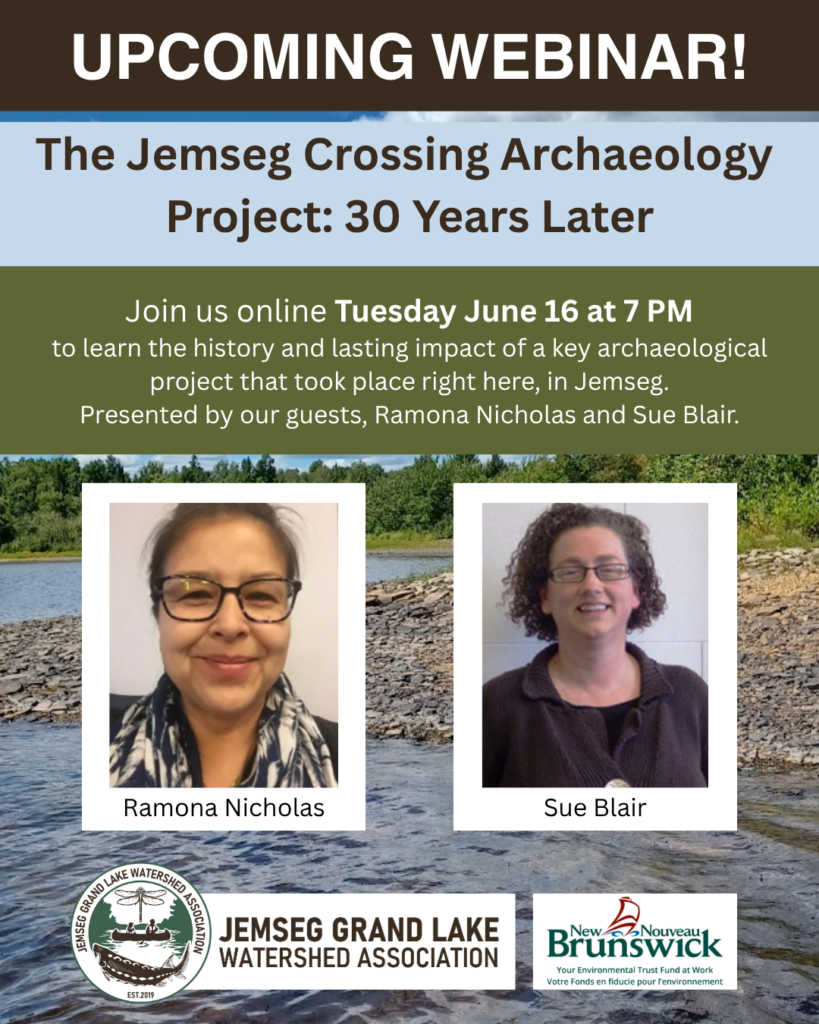
Webinar Announcement – June 16th, 2026

June 2, 2026

The Jemseg Crossing Archaeology Project: 30 years later

As a part of the assessment for a new route for the TransCanada Highway between Fredericton and Moncton, a major archaeological site was identified on the banks of the Jemseg River. The decision was taken to excavate the archaeological material that would otherwise be destroyed by the construction of the highway, and in August of 1996, what would become the largest excavation in eastern Canada began. As it was also the first major excavation taking place under the then relatively new environmental assessment legislation, the project team wanted to establish a strong precedent for how such projects would unfold, emphasizing principles and practices such as respectful, open communication and transparency with the public and leadership of Indigenous nations, involvement of Wolastoqiyik in all parts of the project, and the embedding of training and capacity building for Indigenous team members. At the time, those of us on the project saw ourselves as change-makers, seeking reconciliation through archaeology. In this presentation we reflect on the changes we made, and the challenges that remain ahead of us.

To register for the webinar, please click here

Both Sue Blair and Ramona Nicholas established the early stages of their careers in archaeology through the Jemseg Crossing Archaeology Project.

Ramona Nicholas is the Director of the Mi’kmaq Wolastoqey Centre at UNB, and is a Research Associate in the Department of Anthropology. She has completed a graduate degree in anthropological archaeology, and has published and presented her research on archaeology, heritage, and the lives of Wabanaki Ancestors. In addition to being a Wolastoqiyik scholar, she is a traditional person and pipe carrier, and she leads ceremonial activities both within Wabanaki communities and with Wabanaki people, and for non-Indigenous people seeking reconciliation and knowledge. She is deeply connected to systems of support, healing, and trauma response in her community, and is committed to bringing the people of her community, including children and youth, into a relationship of understanding and respect with the Ancestors through teaching and ceremony.

Sue Blair is currently a Professor of Anthropology at UNB where she studies ancient Wabanaki material culture and lifeways, and examines the practices of archaeology through the lens of reconciliation at the interface between Western epistemologies and Indigenous rights and worldviews. She has worked extensively in collaboration with Wabanaki communities and researchers, and has published and presented these insights in both scholarly contexts and in community-accessible formats. Her insights into archaeological practice were strongly shaped by her role as the archaeological director for the Jemseg Crossing Archaeology Project.

Filed Under: News

What’s under the ice?

December 20, 2024

Peering Into The Winter Fish Community in the Jemseg – Grand Lake Watershed

We’re excited to share some great news about our first eDNA analysis of the fish community in the Jemseg-Grand Lake watershed! This study gives us wonderful initial insights into the biodiversity of fish in this watershed. This initial study helps us along our journey to learn more about our local environment. Please read our short (4 page) article to learn about the fish community in the watershed. We would love to hear back from you so that we can learn more together!

What’s under the ice – JGLWA eDNA report (2024)Download

Filed Under: News

Search This Site

View All Events

JGLWA On X (formerly Twitter)

Jemseg Grand Lake Watershed Association Follow

Working together to achieve our goal: a healthy watershed ecosystem for all.

JemsegA
jemsega Jemseg Grand Lake Watershed Association @jemsega ·
9 Jun

Jemseg Grand Lake Watershed Association - June 9 2026 Meeting Reminder and Webinar Announcement - https://mailchi.mp/37bd29fac75c/jemseg-grand-lake-watershed-association-may-2023-newsletter-17448507

jemsega Jemseg Grand Lake Watershed Association @jemsega ·
2 Jun

Jemseg Grand Lake Watershed Association - June 9 2026 Meeting Reminder and Webinar Announcement - https://mailchi.mp/c356d9f8991b/jemseg-grand-lake-watershed-association-may-2023-newsletter-17448324

jemsega Jemseg Grand Lake Watershed Association @jemsega ·
4 May

Jemseg Grand Lake Watershed Association - May 4 2026 Meeting Reminder - https://mailchi.mp/04e7c7b6d07c/jemseg-grand-lake-watershed-association-may-2023-newsletter-17447786

JGLWA on Facebook

Jemseg Grand Lake Watershed Association

3 days ago

Jemseg Grand Lake Watershed Association
Let’s meet a new fish each Friday! This fish was included in the Department of Natural Resources and Energy Development August 2022 Report for at least one of our lakes.The Blueback Herring (Alosa aestivalis) is often confused with the Alewife due to their similar appearances. The Blueback Herring has smaller eyes, a lesser body depth, and a dark interior peritoneal lining.It is recorded as living in Grand Lake, and doesn’t live much further inland. They spawn in fresh water, then return to the sea.#fish #newbrunswick #nature #conservation ... See MoreSee Less
View on Facebook
· Share

Share on Facebook Share on Twitter Share on Linked In Share by Email

Jemseg Grand Lake Watershed Association

6 days ago

Jemseg Grand Lake Watershed Association
Join us online Tuesday June 16 at 7 PM to learn the history and lasting impact of a key archaeological project that took place right here, in Jemseg.Presented by our guests, Ramona Nicholas and Sue Blair.Please follow this link to register for the webinar us02web.zoom.us/webinar/register/WN_RCn8n1-jS5a_QdRYc8OmyQ#/registration ... The Jemseg Crossing Archaeology Project: 30 years laterAs a part of the assessment for a new route for the TransCanada Highway between Fredericton and Moncton, a major archaeological site was identified on the banks of the Jemseg River. The decision was taken to excavate the archaeological material that would otherwise be destroyed by the construction of the highway, and in August of 1996, what would become the largest excavation in eastern Canada began. As it was also the first major excavation taking place under the then relatively new environmental assessment legislation, the project team wanted to establish a strong precedent for how such projects would unfold, emphasizing principles and practices such as respectful, open communication and transparency with the public and leadership of Indigenous nations, involvement of Wolastoqiyik in all parts of the project, and the embedding of training and capacity building for Indigenous team members. At the time, those of us on the project saw ourselves as change-makers, seeking reconciliation through archaeology. In this presentation we reflect on the changes we made, and the challenges that remain ahead of us.BIOGRAPHIES:Both Sue Blair and Ramona Nicholas established the early stages of their careers in archaeology through the Jemseg Crossing Archaeology Project. Ramona Nicholas is the Director of the Mi’kmaq Wolastoqey Centre at UNB, and is a Research Associate in the Department of Anthropology. She has completed a graduate degree in anthropological archaeology, and has published and presented her research on archaeology, heritage, and the lives of Wabanaki Ancestors. In addition to being a Wolastoqiyik scholar, she is a traditional person and pipe carrier, and she leads ceremonial activities both within Wabanaki communities and with Wabanaki people, and for non-Indigenous people seeking reconciliation and knowledge. She is deeply connected to systems of support, healing, and trauma response in her community, and is committed to bringing the people of her community, including children and youth, into a relationship of understanding and respect with the Ancestors through teaching and ceremony.Sue Blair is currently a Professor of Anthropology at UNB where she studies ancient Wabanaki material culture and lifeways, and examines the practices of archaeology through the lens of reconciliation at the interface between Western epistemologies and Indigenous rights and worldviews. She has worked extensively in collaboration with Wabanaki communities and researchers, and has published and presented these insights in both scholarly contexts and in community-accessible formats. Her insights into archaeological practice were strongly shaped by her role as the archaeological director for the Jemseg Crossing Archaeology Project. ... See MoreSee Less
View on Facebook
· Share

Share on Facebook Share on Twitter Share on Linked In Share by Email

Jemseg Grand Lake Watershed Association

1 week ago

Jemseg Grand Lake Watershed Association
Let’s meet a new fish each Friday! This fish was included in the Department of Natural Resources and Energy Development August 2022 Report for at least one of our lakes.The Blacknose Dace (Rhinichthys atratulus) is not just black on the nose; the whole lateral line is dark. This dark line turns orange on male Dace during breeding season.Like many aquatic animals, Blacknose Dace eat pretty much anything they can get in their mouth. Unfortunately for this small fish, the reverse is also true. It is common prey for many animals.#fish #newbrunswick #nature #conservation ... See MoreSee Less
View on Facebook
· Share

Share on Facebook Share on Twitter Share on Linked In Share by Email

Contact Us

Jemseg Grand Lake Watershed Association
27 Pine Grove Lane
Jemseg, NB E4C 4L7

Search Our Site

Copyright © 2026 Jemseg Grand Lake Watershed Association