Our webinars are quite popular with members and nonmembers alike. All of our webinars are available for viewing on our YouTube channel. Click any of the links below to go to a specific webinar posted on YouTube.
The Jemseg Crossing Archaeology Project: 30 Years Later | Eurasian Watermilfoil – An Invasive Species Update | Ecosystem recovery from Minto coal mining: a fascinating story | Using Environmental DNA to Understand Aquatic Ecosystems | Natural History and Geological Evolution of the Jemseg Grand Lake Watershed – a timely story | Jemseg Grand Lake Watershed Aquatic Ecosystem: What We Know and Don’t Know After Two Years | Identifying Cyanobacteria | Flooding in New Brunswick | Understanding Lake Water Quality | Cyanobacteria in New Brunswick
The Jemseg Crossing Archaeology Project: 30 Years Later
As a part of the assessment for a new route for the TransCanada Highway between Fredericton and Moncton, a major archaeological site was identified on the banks of the Jemseg River. The decision was taken to excavate the archaeological material that would otherwise be destroyed by the construction of the highway, and in August of 1996, what would become the largest excavation in eastern Canada began. As it was also the first major excavation taking place under the then relatively new environmental assessment legislation, the project team wanted to establish a strong precedent for how such projects would unfold, emphasizing principles and practices such as respectful, open communication and transparency with the public and leadership of Indigenous nations, involvement of Wolastoqiyik in all parts of the project, and the embedding of training and capacity building for Indigenous team members. At the time, those of us on the project saw ourselves as change-makers, seeking reconciliation through archaeology. In this presentation, we reflect on the changes we made and the challenges that remain ahead of us. This recorded webinar features Sue Blair (UNB) and Ramona Nicholas (UNB).
Eurasian Watermilfoil – An Invasive Species Update
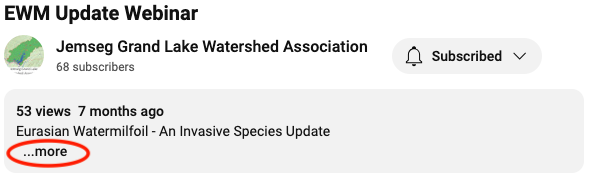
A recorded webinar hosted by aquatic ecologist Mikael Gyllström. How do you clearly recognize Eurasian Watermilfoil (EWM)? Why is it so invasive? How is it affecting the Jemseg Grand Lake Watershed and other New Brunswick watersheds like the Kennebecasis River Watershed? Watch this excellent video as Mikael leads a lively discussion with presenters Meghann Bruce (Research Scientist with the Canadian Rivers Institute), Laura Lavigne (EWM removal pilot project coordinator) and Ben Whalen (Executive Director of the Kennebecasis Watershed Restoration Committee).
Note that the video is fully indexed. Once the video starts playing, click on the “YouTube” button to watch on YouTube, and then select the “Show more” button as indicated in the image below. You can then go directly to the topic of interest by clicking on the blue hh:mm:ss letters of the index.
Ecosystem recovery from Minto coal mining: a fascinating story
A recorded webinar presented by Peter Dufour, Operations Superintendant at Énergie NB Power. Peter grew up in Minto, N.B. and joined NB Coal Ltd. in 1977. He has unique and deep knowledge of the former coal mining operations in Minto, New Brunswick, and in the land reclamation processes and water quality monitoring processes used for ecosystem recovery from coal strip mining operations. When did coal mining start in the Minto, New Brunswick area? What environmental, social and financial impacts has it had over the years? How has the water quality of fresh water runoff from the mine tailing ponds changed over time? Why are the ponds that beautiful aquamarine colour? Are the ponds safe to swim in? How extensive are the mine tailings? What are the future plans for ecosystem improvement in the mine tailings areas? Watch this excellent video presentation to find out the answers to these and other questions.
Note that the video is fully indexed. Once the video starts playing, click on the “YouTube” button to watch on YouTube, and then select the “Show more” button as indicated in the image below. You can then go directly to the topic of interest by clicking on the blue hh:mm:ss letters of the index.

Using Environmental DNA to Understand Aquatic Ecosystems
A recorded webinar presented by Scott Pavey, a Full Professor at the University of New Brunswick in Saint John, Dept. of Biological Sciences, and Canada Research Chair in Aquatic Molecular Ecology and Ecological Genomics. Watch and learn how water samples can be used to determine species’ presence and abundance in Aquatic ecosystems. Can eDNA provide any quantitative data on the number of a specific species present? Are there differences when using eDNA techniques in rivers and streams compared to lakes? What species are present in Grand Lake? Can eDNA (environmental DNA) analysis answer the question “Are inner Bay of Fundy Atlantic salmon in Salmon River?” What does eDNA testing cost? What field methods work best for collecting useful samples for eDNA testing? Is eDNA better at species identification than electrofishing? Watch this excellent video presentation to find out the answers to these and other questions.
Note that the video is fully indexed. Once the video starts playing, click on the “YouTube” button to watch on YouTube, and then select the “Show more” button as indicated in the image below. You can then go directly to the topic of interest by clicking on the blue hh:mm:ss letters of the index.

Natural History and Geological Evolution of the Jemseg Grand Lake Watershed – a timely story
A recorded webinar presented by Toon Pronk, a professional geologist. Watch and learn the fascinating story of how the Jemseg Grand Lake watershed and the lower Wolastoq (Saint John River) ecosystem arose. How did coal come to be available in Minto, but not in Jemseg? How did the unique Grand Point Bar extending a kilometre into Grand Lake arise? Why is the Portobello Creek National Wildlife Area so prone to flooding during the spring freshet compared to other areas around it? How did 300 million year old fossils come to be in the rocks around Grand Lake? What might future New Brunswick watersheds look like? Watch this excellent video presentation to find out the answers to these and other questions.
Note that the video is fully indexed. Once the video starts playing, click on the “YouTube” button to watch on YouTube, and then select the “Show more” button as indicated in the image below. You can then go directly to the topic of interest by clicking on the blue hh:mm:ss letters of the index.

Jemseg Grand Lake Watershed Aquatic Ecosystem
A March 17, 2022 recorded Zoom webinar presented by Eric Luiker, leader of our Association’s volunteer water quality observation program and a professional aquatic ecologist. Eric presents results from our 2021 water quality observation program, and compares 2021 results with those from 2020. The webinar has some excellent discussion, questions with answers and an interesting interactive response to five important questions addressing future watershed aquatic ecosystem activities.
Identifying Cyanobacteria
Dr. Meghann Bruce, Research Scientist, Canadian Rivers Institute, explains current and planned research for detecting and verifying potentially harmful cyanobacteria. Dr. Bruce clearly describes the challenges in understanding the proliferation of benthic, mat-forming, freshwater cyanobacteria, and how cyanobacteria (sometimes called “blue-green algae”) is different from algae. New Brunswick cyanobacteria research started in 2018 when three dogs in the Fredericton area died from ingesting toxic cyanobacteria containing anatoxin-a. Dr. Bruce has been leading field cyanobacteria research in New Brunswick since this tragic event, and illustrates well how to identify cyanobacteria. Dr. Bruce also answers a number of questions from webinar attendees.
Flooding in New Brunswick
On January 14, 2021, Jasmin Boisvert presented a webinar entitled “Flooding in New Brunswick: Cause and Effect“. Jasmin is a water resources specialist with the N.B. Department of Environment and Local Government and works in the Hydrology Centre as part of the N.B. River Watch team. Since joining the Department in 2016, he has primarily been working on the province’s flood hazard mapping initiatives, updating the province’s flood forecasting/modelling tools, and providing advice and expertise related to provincial water resources.
Understanding Lake Water Quality
On November 30, 2020, Eric Luiker presented a webinar entitled “Understanding Lake Water Quality: First Steps for Grand Lake, New Brunswick“. Eric is an experienced aquatic ecologist, and fish biologist. He has investigated water quality in lakes and rivers in 8 provinces (including Labrador), and in the high Arctic in Nunavut. Eric kindly led our Association’s volunteer water quality observation program during the summer of 2020.
Cyanobacteria in New Brunswick
On July 16, 2020 we held our first webinar entitled “Cyanobacteria in New Brunswick: Understanding Toxicity” given by Dr. Janice Lawrence, a UNB professor of biology. Dr. Lawrence is currently investigating the distribution of toxin-producing cyanobacteria in New Brunswick waterbodies using genetic tools.

